

Aave’s native cryptocurrency could reach $175 under a one-year base-case scenario as asset managers increasingly apply traditional finance valuation models to decentralized finance (DeFi) tokens, according to a new report by Grayscale Research.
The digital asset manager said Aave could generate about $60 million in net income in 2026 and placed the token’s current fair value at $80 to $100. The analysis used discounted cash flows, earnings multiples and comparisons with banks and fintech companies. Aave traded at $75 on Thursday, according to CoinGecko.
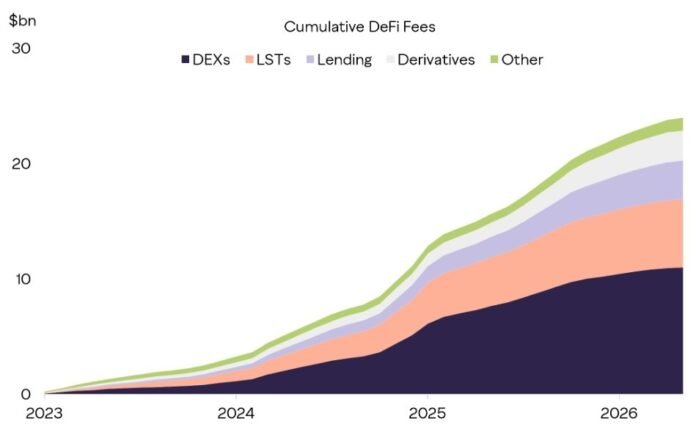
Grayscale said Aave’s revenue rose more than sixfold between 2023 and 2025, while the protocol operates at an estimated 50% margin. It argued that Aave’s lending activity, GHO stablecoin and institutional products could support future earnings growth.
However, protocol revenue alone doesn’t guarantee token value, the research added. Fees may be paid to liquidity providers, used for operating costs or retained by a decentralized autonomous organization, while token holders generally lack legally enforceable claims held by shareholders.
Grayscale’s analysis applies valuation methods commonly used for equities, banks and fintech companies to a DeFi protocol, reflecting the firm’s view that some crypto assets generate sufficiently measurable revenue and earnings to be evaluated using traditional financial frameworks.
Cumulative DeFi fees. Source: Grayscale Research
CoinShares applies long-term valuation models to HYPE and Ether
CoinShares has taken a similar approach to Hyperliquid’s HYPE token and Ether (ETH), using protocol fees, buybacks and other economic drivers to create long-term valuation frameworks. The asset manager’s 2031 base case values HYPE at $147 and ETH at $4,935, although most of the projected ETH value comes from the token’s collateral and monetary role rather than cash flows.
CoinShares described Hyperliquid as a more direct example of token-level value accrual because 99% of protocol fees are used to buy back HYPE through its Assistance Fund. For Ether, it used a sum-of-the-parts framework combining projected cash flows with a larger monetary and collateral premium.
Related: Botanix to shut down after 4 years, cites weak demand for Bitcoin DeFi
The valuation work by Grayscale and CoinShares comes as some financial institutions forecast stronger growth in DeFi markets.
Standard Chartered forecasts that tokenized assets could lift DeFi assets to $2.7 trillion by 2030. The bank said Uniswap is positioned to become a major venue for tokenized markets, adding that traditional finance partnerships could help Uniswap attract more activity.
Magazine: The end of anon? AI could unmask crypto’s hidden identities