

Hyun Song Shin, the governor of the Bank of Korea, praised tokenization for its ability to simplify the issuance and management of government bonds.
Shin said during a Wednesday panel discussion at the European Central Bank (ECB) Forum on Central Banking in Sintra, Portugal, that tokenized bonds would make it easier to verify collateral, credit the asset provider’s account and reverse transactions at the appropriate time.
“The big prize is tokenizing government bonds,” Shin said, adding that it is “much easier, much less prone to mistakes if you have everything tokenized.”
US Treasury debt is the largest tokenized real-world asset category, representing $14.6 billion, or about 46% of the $31.7 billion RWA market, according to data provider RWA.xyz.
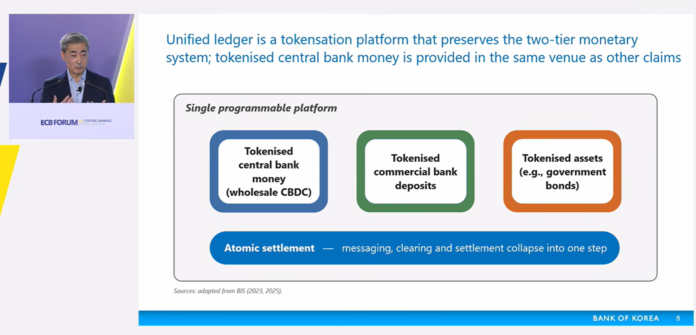
Shin also outlined plans to bring tokenized government bonds, wholesale central bank digital currencies and tokenized commercial bank deposits on a unified ledger, as part of an extension to “Project Hangang,” a Bank of Korea-led pilot project testing a blockchain-based wholesale CBDC system.
Hyun Song Shin, governor of the Bank of Korea, speaks during a panel discussion at the ECB Forum on Central Banking. Source: YouTube
Tokenized government bonds may boost financial innovation: BIS
Government bond tokenization could improve market efficiency and support financial innovation, provided regulatory and infrastructure challenges are addressed, according to a July 2025 report by the Bank for International Settlements (BIS).
Related: Former BIS chief softens stance on stablecoins, backs coexistence with fiat
Government securities play a crucial role in the financial system, acting as a savings vehicle for households and firms and as collateral in a range of transactions, the report said, adding:
“By enabling the contingent execution of actions, tokenisation can help to enhance the efficiency of markets, reduce settlement risk, broaden investment access and spur the creation of new financial services.”
The report examined 39 tokenized bonds, including 24 issued by corporations and 15 by governments. Compared with traditional, non-tokenized bonds, the BIS found “suggestive evidence” of lower bid-ask spreads and comparable issuance costs and yields.
Tokenized bonds vs conventional, non-tokenized bonds, liquidity, issuance costs. Source: BIS
Magazine: Guide to the top and emerging global crypto hubs: Mid-2026