

Digital asset custodian Anchorage Digital has added native TRX staking for institutional clients, expanding its support for the Tron blockchain as demand for regulated access to staking services grows.
The launch expands Anchorage’s support for Tron after introducing institutional custody for TRX, the network’s native token, earlier this year. Clients can now stake TRX directly from the company’s custody platform or Porto self-custody wallet, allowing them to earn protocol rewards for helping secure the blockchain without moving assets outside their existing custody environment.
Anchorage said the expansion reflects growing institutional interest in the Tron ecosystem, one of the largest networks for USDt (USDT) settlement. According to the company, Tron processed roughly $2 trillion in USDT transfers during the first quarter of 2026 while averaging 10.9 million daily transactions and 3.2 million active addresses. Tether’s transparency data shows nearly $90 billion of USDT currently circulates on the network.
The Tron rollout follows Anchorage’s broader expansion of institutional staking services. In November, the company partnered with Figment to add HYPE staking, extending custody-integrated staking support to the Hyperliquid ecosystem.
Related: Ethereum’s much-hated staking ‘tax’ may already be obsolete
Institutional platforms expand beyond custody
Institutional crypto infrastructure providers have increasingly expanded beyond custody, adding staking capabilities as investors seek regulated ways to earn returns on digital assets.
In October 2025, Coinbase and Figment expanded their institutional staking partnership, allowing Coinbase Prime clients to stake proof-of-stake assets including Solana (SOL), Avalanche (AVAX), Sui (SUI) and Aptos (APT) directly from custody. Four months later, Ripple integrated Figment and Securosys into its institutional custody platform, enabling banks and custodians to offer staking without having to operate their own validator infrastructure.
Asset managers have also sought integrated custody and staking services. In February, BitGo expanded its partnership with 21shares to provide regulated custody and staking for the firm’s US exchange-traded funds and global exchange-traded products through its regulated US and European entities.
Corporate crypto treasuries have joined the trend as well. Bitmine launched its MAVAN staking platform in March, having initially built the validator infrastructure for its own Ether treasury and later opening it to external institutions and custodians.
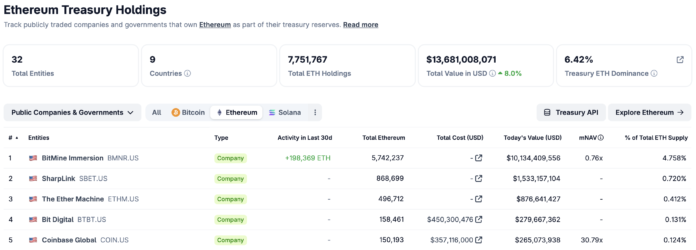
On Monday, Bitmine said it holds 5.77 million ETH, representing about 4.8% of Ether’s total supply, and has staked 4.92 million ETH through MAVAN.
Top Ethereum treasury companies. Source: CoinGecko
Magazine: Robinhood L2 sparks ETH optimism, Saylor ‘muddies waters.’ Hodler’s Digest, July 5-12, 2026