

Ethereum could begin adding post-quantum protections to accounts for as little as $0.07, without waiting for a hard fork, according to the Ethereum Foundation’s Kohaku project lead Nicolas Consigny.
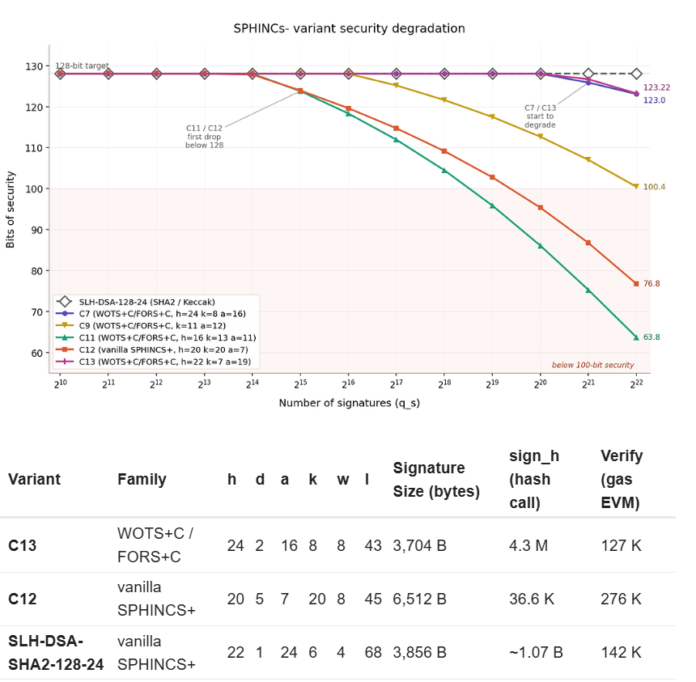
In a Saturday X post, Consigny shared a paper proposing a cheaper way for Ethereum users to protect their accounts against future quantum-computing threats. The approach adapts SPHINCS+, a post-quantum signature standard developed by the US National Institute of Standards and Technology, to work more efficiently on Ethereum.
Dubbed “SPHINCS-,” the proposal aims to reduce onchain verification costs without requiring a protocol change or precompile. Consigny described SPHINCS- as a bridge toward a future post-quantum signature system dubbed “leanSPHINCS,” which aims to further reduce verification costs through aggregation.
The proposal seeks to address the long-term risk of a quantum threat to Ethereum’s Elliptic Curve Digital Signature Algorithm with a cost-efficient solution that may be deployed before a dedicated hard fork is developed.
Signature scheme SPHINCs variant security degradation and onchain verification costs. Source: Ethresearch.ch
Related: Adam Back says Bitcoin’s post-quantum shift may reveal true Satoshi stash
Future quantum computing threats stirs crypto community
In April, post-quantum startup Project Eleven awarded a prize to researcher Giancarlo Lelli for using a quantum computer to break a 15-bit elliptic-curve key.
Bitcoin’s keys are 256 bits long, significantly larger than the 15-bit key Lelli managed to crack. He derived the private key from a public key paired to it, using a variant of Shor’s algorithm, a quantum computing technique that theoretically poses a threat to the type of cryptography used by Bitcoin.
According to Glassnode, about 1.92 million Bitcoin, representing nearly 10% of the total supply, are considered “structurally unsafe” in a future quantum attack scenario. Another 4.12 million BTC, or 20.6% of the supply, are classified as “operationally unsafe” due to key or address management practices.
Source: Glassnode
The analytics company estimates that the remaining 69.8% of the supply, or 13.99 million Bitcoin, remains unexposed to a quantum computing threat, broadly in line with Ark Invest’s March estimate that 65% of the supply was safe.
Magazine: Bitcoin vs. the quantum computer threat — Timeline and solutions (2025–2035)